![b8418dc3-0886-4e57-a609-b76b4a600d63.png]](https://help.ratiocoffee.com/hs-fs/hubfs/b8418dc3-0886-4e57-a609-b76b4a600d63.png?height=42&name=b8418dc3-0886-4e57-a609-b76b4a600d63.png)
Introduction
Does the flavor of your brew leave more to be desired? Fortunately, if you run into a brew with your Ratio Four that is not vibing with your palate, there are ways to troubleshoot this. We call this process "dialing in". Coffee brewing often has many factors that go into making the perfect cup, and it may be confusing which variable to turn to first. In this article, we will dive into several of the factors to consider when getting your coffee to taste right on your Four. Most of these concepts will be true for all coffee brewing processes.
Grind Size
Where do I start?
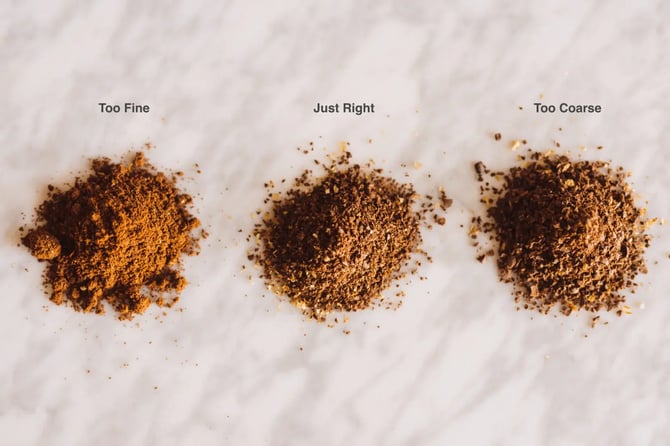
Ratio recommends using a medium-coarse grind size for our coffee makers!
All grinders have a different range and different burrs, therefore, this may take some practice to dial in your routine. A grind size coarser than 'pour over' and finer than 'French press' is a good range to start within. Try referring to the grinder's operation manual for a specific grind setting or range.
Dialing in: Under-extraction vs. Over-extraction
Your taste buds are the most important tools to help move your brew's extraction in the right direction. Ideally, the coffee will taste sweet, balanced, transparent, and have a full mouthfeel to highlight the best qualities of the coffee you're brewing. Below, you will get to understand the qualities of under-extraction and over-extraction, and how grind size can be used to improve your brew:
-
Under-extraction may present weak, salty, sour, and/or having a quick finish. To help resolve under-extraction, make the grind size finer, which will boost extraction.
-
Over-extraction may present dry, harsh on the tongue, and/or hollow in flavor. To help resolve over-extraction, make the grind size coarser, which will lessen extraction.
Having one go-to grind size, when switching up the type of coffee you're brewing, is a great way to have a simple starting-point before changing the grind.
Coffee Dosing and Coffee-to-Water Ratios
Having an optimal coffee-to-water ratio is important when considering the concentration of coffee molecules and oils in your brew. Using too much or too little coffee can negatively impact the strength and balance of the extraction.
How does the amount of coffee-to-water impact the extraction?
Most of the coffee molecules and oils are extracted at the beginning of the brew cycle. As the cycle advances, less flavor can be extracted. That means:
- The more coffee you add to a set amount of water, the stronger your brew will be.
- The less coffee you add to the same set amount of water, the weaker your brew will be.
Where do I start?
Fortunately, Ratio has recommended where to start to keep it simple. Below is a chart of Ratio's recommended coffee dosage to water volumes to brew on your Ratio Four!
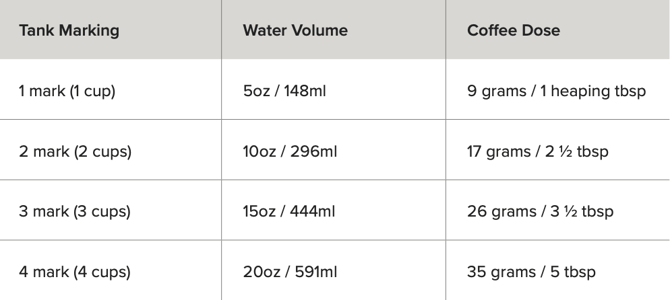
The recommendations above reflect coffee-to-water ratios that are 1 part coffee to 17 parts water, which is a common ratio for pour-over style coffee. You can eventually modify the recipe and try different coffee doses, if desired. Finding the right ratio for you may take some experimentation, and it's important to allow your tastebuds to drive your way in the direction of your ideal recipe. If you decide to make any dosing changes, incrementally change the amount of coffee-to-water until you get something that satisfies your tastebuds.
The Ratio Four's Bloom Settings
The Bloom Phase is the first phase of the brew cycle. The Ratio Four will deliver a small amount of hot water to saturate the coffee grounds in preparation for the full brewing cycle. This step is necessary to saturate the coffee and to allow naturally occurring CO2 to be released, which is a byproduct of sugar browning during the coffee roasting process. The bloom is an important step in the brewing process to ensure that coffee is brewed evenly and the flavor isn't hindered by the presence of carbon molecules in the end product of the cup.
If your coffee is not tasting good, consider that the Ratio Four has two bloom cycles to select from. The Standard Bloom setting is recommended for half to full batches on the Ratio Four. The Short Bloom setting is recommended for half batches and below.
-
Standard Bloom: Press the start button briefly to start the standard bloom. The Four will dispense roughly 4 oz or 120 grams of hot water before pausing.
-
Short Bloom: Hold the start button for 3 seconds to activate a smaller bloom. The Four will dispense roughly 2 oz or 60 grams of hot water before pausing.
Filter Type
The Ratio Four includes accessories that utilize an 8-12 cup flat-bottom-style filter. Below is our recommended filters to use with your Ratio Four.
Ratio Paper Filters for the Ratio Four are a perfect option to maximize filtration and adequately drain while brewing. Our paper filters ensure the best flavor outcome when it comes to quality of the paper and the clean cup it produces.
Store-bought name brand filters often are relatively thin and may have a waxy layer that hinders drainage during the brewing process. That being said, Melitta 8-12 cup flat-bottom paper filters often will work with the Ratio Four. Ratio Paper Filters are sold at RatioCoffee.com.
Quality Control
If your coffee isn't tasting good, and it's not a dialing-in issue, you could be faced with quality issues within the realm of Coffee Quality, Water Quality, and/or Cleanliness of your Ratio.
Water Quality
At Ratio, we love discussing the importance of water quality since water is the main ingredient that goes into the coffee you're drinking in the morning. We recommend using filtered water, because it's ideal to promote an optimally balanced flavor of coffee. This is thanks to its ideal mineral content.
Having too many minerals, will hinder the extraction process. Higher mineral content is one reason why tap water is not recommended to use in your Ratio. A heavy mineral content often results in under-extraction, which is lacks flavor and acidity. Consequentially tap water will also influence rapid accumulation of limescale inside your Ratio.
Reverse Osmosis or distilled water, on the other hand, will influence over-extraction. You can expect a brew with high acidity due to there being a lack of alkalinity, or minerals. For water without minerals, you can add minerals back into the water using products such as Third Wave Water, to enhance your coffee tasting experience!
Coffee Quality
Coffee quality has a major impact on flavor, and differences in origin, processing, and roast profile can dramatically change the taste in your cup.
If your coffee isn't tasting its best and you purchase a shelf brand at the grocery store, try buying from a local specialty roaster! Small roasters typically roast fresh coffee weekly, maintain stricter quality control, and include a roast date on every bag so you know exactly how fresh it is. If you don't own a grinder, most roasters and cafes will also grind the coffee to suit your brewing method.
Freshly roasted coffee generally tastes best 1–4 weeks after roasting, when the beans still contain an ideal amount of CO₂. As coffee ages, that CO₂ gradually escapes, leading to a flatter, less vibrant cup. Pre-ground coffee loses freshness even faster. Coffee that has sat on a grocery store shelf for months will often lack the flavor and aroma of freshly roasted beans, and over time, the oils in old coffee can become rancid, resulting in unpleasant flavors.
In short, the best coffee starts with high-quality, freshly roasted beans and is ground just before brewing.
Keeping your Ratio Clean
Descaling your coffee maker monthly will promote the prevention of limescale from sticking to the internals of your Ratio, and also to ensure cleanliness for fresher tasting coffee. To learn more about how to descale your Ratio, click here!
Summary
Overall, no matter your routine, it's helpful to start at the same point for the first brew after buying a new bag of coffee. Find a go-to starting grind size and coffee-to-water ratio that works for you, in most cases. A coffee might brew and extract differently than you expect, and following the scientific method by only changing one variable at a time is the best way to better understand what variable changed the extraction, regardless if the change was ideal. Always consider the quality of ingredients you use, because low quality ingredients will be show through in your morning brew. Cleaning your machine will both maintain your Ratio's function, and also prevent weird flavors from making it into your coffee.
Remember to keep an open mind, and our team at Ratio is always happy to help. Happy brewing!